

Parkour Exercise – Precision
Parkour Exercise - Learn Precision
A precision has, as the name suggests, something to do with precision. It is a movement that involves landing in a certain place in balance. Precisions can be performed at many different levels and are one of the elements in parkour that can always be developed and built on.
Setup
A precision should only be carried out on dry and non-slip surfaces. Precisions can be used on both walls, ledges and rails (handrails). The better you become, the smaller the requirement for the size of the landing surface. It is therefore a good investment to spend time learning the correct technique.
Execution of standing precision
- You are standing in front of the gap that you want to pass. Focus and imagine where on the opposite side you want to place your feet in the landing.
- Stand in good balance with a little distance between your feet, and bend your legs slightly to get good suspension in the landing.
- Lean forward and swing when you feel you have reached the extreme point. Swing strongly forward with your arms, at the same time as you kick off with maximum force from the edge with your legs.
- It is very important that you pull your knees well under you in the hover phase and focus on your landing point.
- As you approach the landing, you stretch your legs out and prepare to absorb the shock of the landing and pick up speed by bending your legs almost completely together.
- Concentrate on landing on the front pads of the foot. This provides the softest and most slip-resistant landing. To prevent you from getting a "tsuk" (a term used in the world of gymnastics for a shock to the ankle that feels like the impact paralyzes the upper part of the instep) it is important that you bring your feet together on landing and spring well.
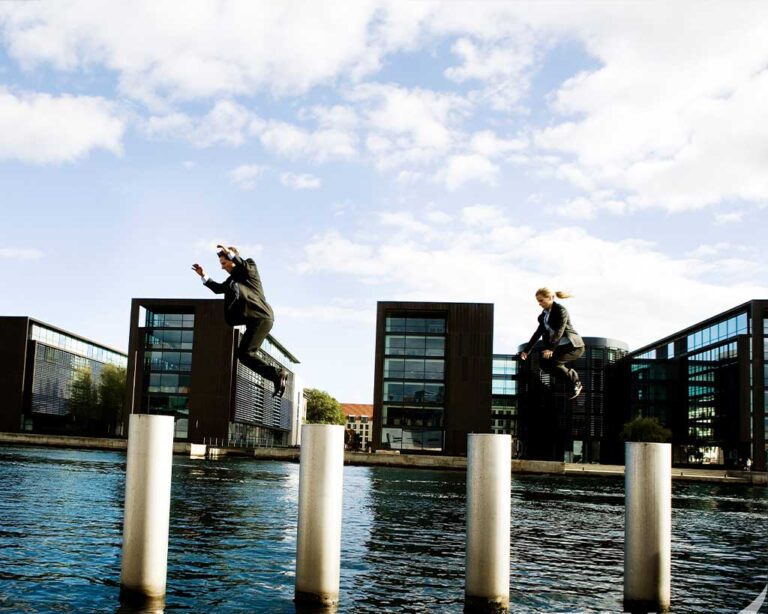
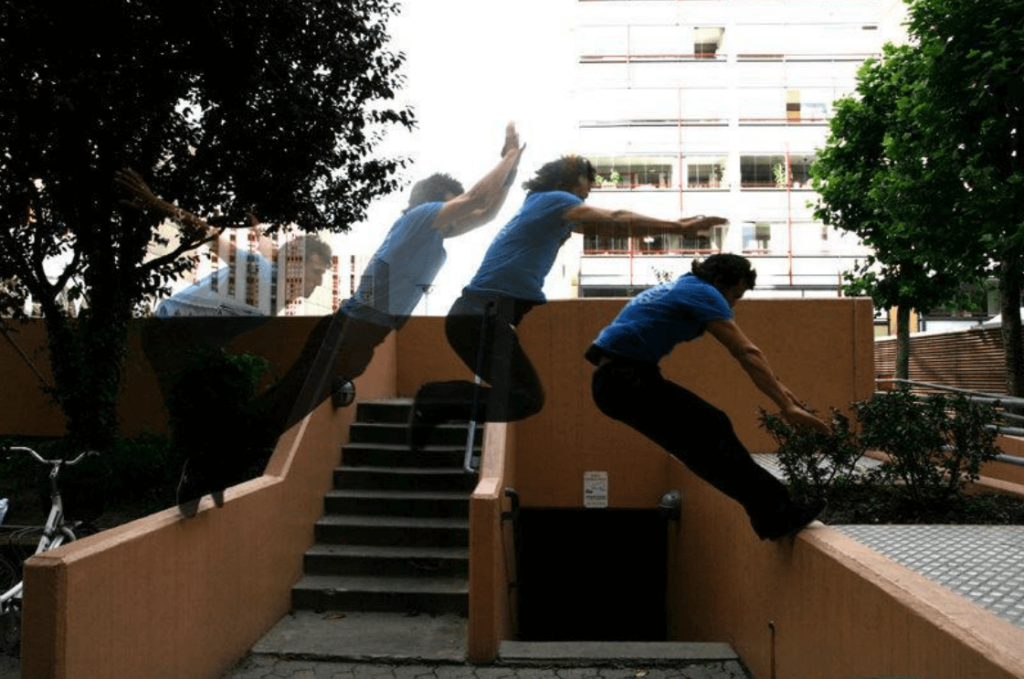
Rehearsal
A good practice for precision is to use a couple of Europa pallets, as you can adjust the distance between them yourself.
This makes it possible to start with them close together and just as quietly increase the distance.
When you need more of a challenge, you can flip the pallets over and use the narrower boards on the underside.
To help yourself remember how long precisions you can do, you can count how many times your foot length you can jump.
This is a very good rule of thumb for many traceurs when they are out challenging new areas.
Training in the gym
Step by step:
1) Start the exercise by standing on the floor and going through the technique in the jump.
- Focus on the following points (but no more than two at a time):
- Lean forward.
- Swing vigorously with arms and legs.
- Pull the legs up under the body in the floating phase.
- Land on the front foot and catch the landing by springing.
- Focus on a maximum of two things at a time.
2) Use the lines on the floor. Set off from a line on the floor. Test how far the students can jump and ask them to count how many times their foot length is to the line they set off from. In this way, they become aware of exactly how far they can jump.
3) Train students to take off and land at a specific point, e.g. a line.
4) Use e.g. step benches, the tops of wooden plinths or European pallets to practice precision between. Continuously adjust the distance and height so that there is a constant challenge for the students.