

Parkour Exercise – Two-handed Vault
Parkour exercise: How to do the Two-handed Vault.
A two-handed vault is most often used over rails or other narrow obstacles.
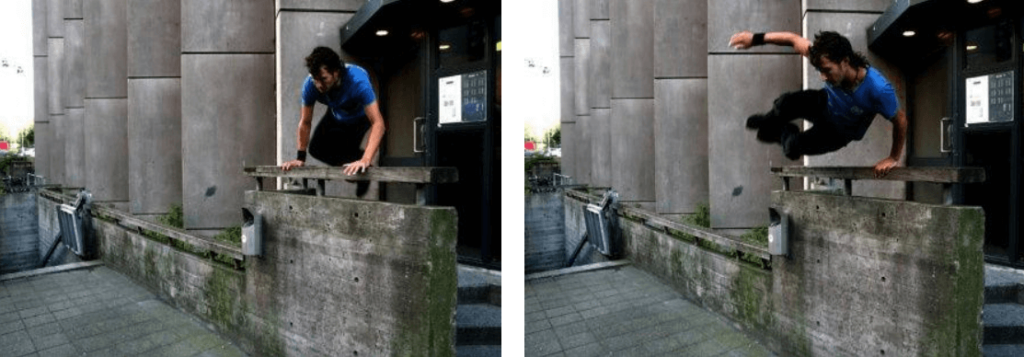
Setup
A narrow obstacle that the athlete goes to between the stomach and the chest. It is a good idea to ensure that there is plenty of space on both sides.
Execution of Two-handed vault
- Start by deciding which side you want to run the legs over the rail.
- Cast off with legs together approx. half a meter from the rail and place both hands on the obstacle.
- Forcefully kick off with the legs out to the side you want them to, while pulling the body over the arms by actively pushing along.
- Pull the legs slightly under your body and release the rail with the arm to the side where the legs swing over the rail.
- Separate your legs slightly on landing so you can continue your flow.
Rehearsals
An exercise for two-handed can be to start from a couple of pallets, so that the landing is higher than the landing.
Problem statement
- It can be difficult to coordinate a strong take-off by swinging the legs out to one side. Train coordination on a lower rail.
Variation options
Two-handed-kick-vault:
Performed by kicking out to the side with the upper leg in a scissor kick movement. Some parkour practitioners find this movement provides better balance.
Training in the gym:
Step by step:
1) Use a wooden boom, placed at the students' hip height.
2) If the students have difficulty getting their legs over the wooden bar, the top of a wooden plinth can e.g. used to set off from.
3) The better the students get, the higher the wooden bar can be raised.
Are you missing an exercise or do you need expert help? Then you can book an instructor from JIYO for private lessons or group lessons / workshop.
Have fun with your parkour training. 🙂