
Parkour Exercise – King Kong Vault
Parkour exercise: How to do the King Kong Vault.
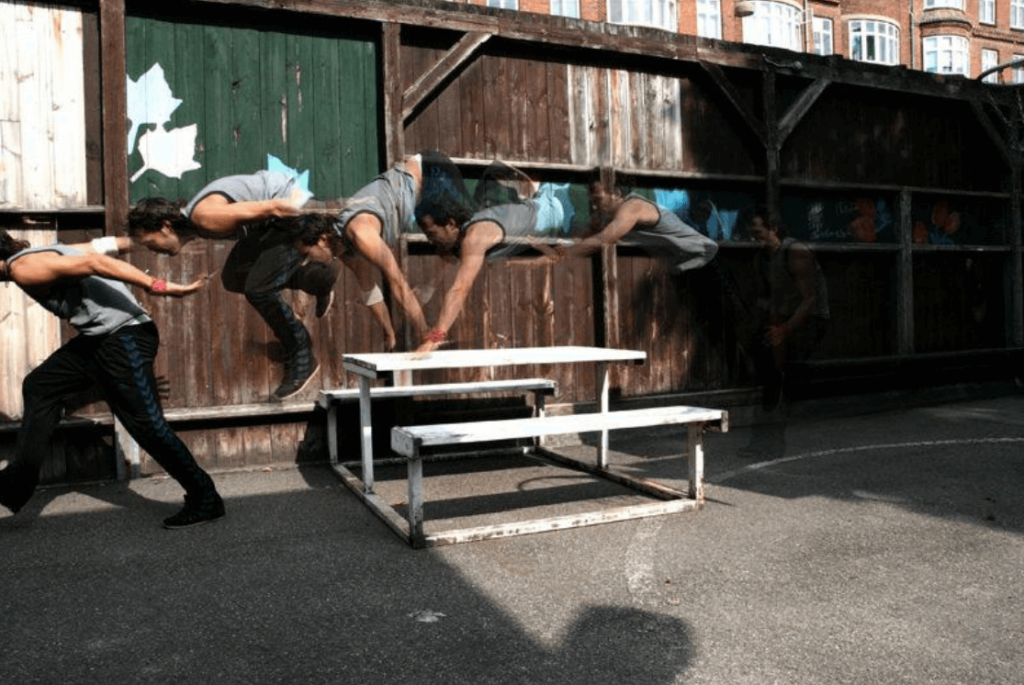
King Kong Vault (also called "King Kong" or "Kong") is used where the Monkeyvault is not sufficient.
In a King Kong, you set off further away from the obstacle and therefore achieve a hovering phase, either because the obstacle is long or because you simply have a lot of speed.
King Kong is an impressive move, as it can be performed over very long distances if you master it. King Kong can be done in two different ways, each with its own quality. In the following, both variations will be described.
Setup
King Kong is an extremely exciting vault, as it is easy to vary. It should be trained on a solid and non-slip obstacle at belly level. Remember to check what is on the other side if there is no clear view.
Execution of King Kong with a unified starting point
- Run towards the obstacle at a medium pace.
- The take-off is performed in a fast-paced and explosive take-off with legs together, slightly further away than in a monkey vault. This gives a longer period of floating in the air, and the possibility of jumping over long ledges. It is extremely important that you tune off flat on the ground, instead of making a high jump. If you do this, you will lose momentum over the obstacle and it will be difficult to maintain a good flow.
- The hands must be placed on the last part of the obstacle. When you have settled with your hands and your legs must be pulled forward, you must be free of the obstacle. Pull the body forward and upwards through the movement with the arms.
- Now the body must be actively straightened. Look forward and stretch your legs down, slightly apart so they are ready to receive the landing so you are able to continue your flow.
Rehearsals
Do a monkey vault a few times so you get used to the technique. Then take off further and further away from the obstacle until you start to feel that you are getting a more lasting hovering phase. If necessary, practice by marking a point one meter away from the ledge and see if you are able to set off from there. Then increase the distance so that you get a longer and longer hover phase.
Problem statement
- Many often find it difficult to dare to let the weight be thrown forward on their hands, as they are afraid of not being able to right themselves again and landing on their head behind the obstacle. However, the higher you raise the rear during the execution, the easier it is.
- It is important that you land with your upper body slightly forward after performing your King Kong Vault. In this way, you maintain the speed of the movement and thus also the flow.
Variation options
Dive King:
Defined by a jump with a long hover phase, which ends in a downward direction. An example: you stand up on a table, run up and jump over and land with your hands on a ledge that is lower or the same height as the table. In the jump you "dive" in the movement, which explains the name Dive Kong.
Double King Kong:
You perform King Kong with two movements with the hands before pulling the legs through. It is important that your hands are placed early and aggressively on the first take, so that it gives you enough momentum to be able to jump on the hands the second time.
It is also important that you kick so much backwards and upwards with your legs that you gain overbalance in the first jump, so that the weight gives you overbalance to be able to complete the second jump as well.
King Kong (kick off with one leg)
A single-leg take-off is used when you have to have a long floating phase after you have settled with your hands. It may be due to an obstacle where there may be is a gap afterwards that you have to cross. It can also be effective if you subsequently want to make a precision.
Performance
- You approach the obstacle straight ahead, at a medium pace.
- In the same way as in a regular King Kong vault, it is important to have an explosive launch. Instead of setting off with your legs together, you make a long, low lunge that ends in a chase. You end the chase by explosively kicking off with one leg forward, after which the other leg must be tilted up behind you, so that you gain height and a horizontal position in the air.
- As the arms are inserted, it is important that you pull the body forward so that the legs can be pulled forward for landing.
- As you approach the landing, like in a king kong vault, it's good if you put one leg in front of the other on the landing so you can continue your run effortlessly. Should you, on the other hand, land precisely, at the same height or slightly lower than at the first obstacle; it is crucial that you pull your legs forward so much that you can land with your toes first and tame the speed by bending your legs together and in that way control the force down into your balance point.
Problem statement
- The chase itself and the landing with the tilt require timing. If it is not done correctly, the approach is destroyed, and there will not be enough momentum to be able to get over the obstacle.
- King Kong with a one-leg stand is not suitable for high walls. Here, the total starting point must be used instead.